Trees can be among the most attractive and valuable features of a garden, but keeping them healthy, safe and appropriate for their surroundings requires ongoing management. Some trees need occasional pruning to control their growth, while others may require crown management, deadwood removal or, in certain circumstances, complete removal.
Understanding the different types of tree surgery can help property owners recognise which service may be suitable for a particular problem. For homeowners in Hindhead, Surrey, professional tree care is particularly valuable when dealing with mature, overgrown or potentially hazardous trees.
At NS Tree Surgery Hindhead, we provide professional tree surgery tailored to the condition, species, size and location of individual trees. Here are some of the most common services and what they are designed to achieve.
Tree Pruning
Tree pruning is one of the broadest areas of tree maintenance and involves selectively removing branches for a specific purpose.
Professional pruning may be used to:
- Remove damaged growth
- Improve branch structure
- Manage excessive growth
- Provide clearance from surrounding features
- Improve the tree’s overall form
Good pruning should have a clear objective. Removing branches unnecessarily or making unsuitable cuts can affect the tree’s future development, which is why knowledgeable assessment is important.
Crown Reduction
Crown reduction decreases the overall height or spread of a tree’s canopy while retaining a balanced natural shape.
It may be appropriate when a tree has become too large for its surroundings or when particular limbs have developed excessive length and weight.
Rather than simply cutting the top from a tree, professional crown reduction involves carefully selecting suitable pruning points throughout the canopy. This helps create a more balanced result and preserves the natural framework of the tree.
Crown Thinning
A mature tree can sometimes develop an excessively dense canopy.
Crown thinning involves selectively removing a proportion of smaller branches from throughout the crown without substantially changing its overall size.
Where appropriate, thinning can:
- Improve airflow through the canopy
- Allow more filtered light through the tree
- Reduce excessive crown density
- Improve the balance of internal growth
The work needs to be distributed carefully so that the tree retains an even appearance.
Crown Lifting
Crown lifting concentrates on the lower part of the canopy.
Selected lower branches are removed or shortened to increase clearance beneath the tree. This can be particularly useful where branches have begun interfering with the normal use of the space below.
Crown lifting can help improve clearance around:
- Garden paths
- Driveways
- Lawns
- Entrances
- Outdoor living areas
Care is needed to ensure that removing lower growth does not leave the tree unnecessarily unbalanced.
Deadwood Removal
Branches naturally die for numerous reasons, including ageing, shading, previous damage and changes within the tree.
Although some deadwood is a normal feature of mature trees, larger dead branches can weaken and eventually break away.
Professional deadwood removal focuses on identifying and removing appropriate dead branches, particularly where they could affect areas regularly used by people or vehicles.
It can also leave the canopy looking considerably tidier.
Tree Cutting and General Canopy Management
Sometimes a tree does not require a specific crown operation but does need general management to keep its growth appropriate for the garden.
This may involve selectively cutting back branches that:
- Extend excessively across the garden
- Grow towards nearby structures
- Interfere with other vegetation
- Obstruct usable outdoor areas
- Have developed undesirable growth patterns
The objective should be to solve the particular problem without removing more healthy growth than necessary.
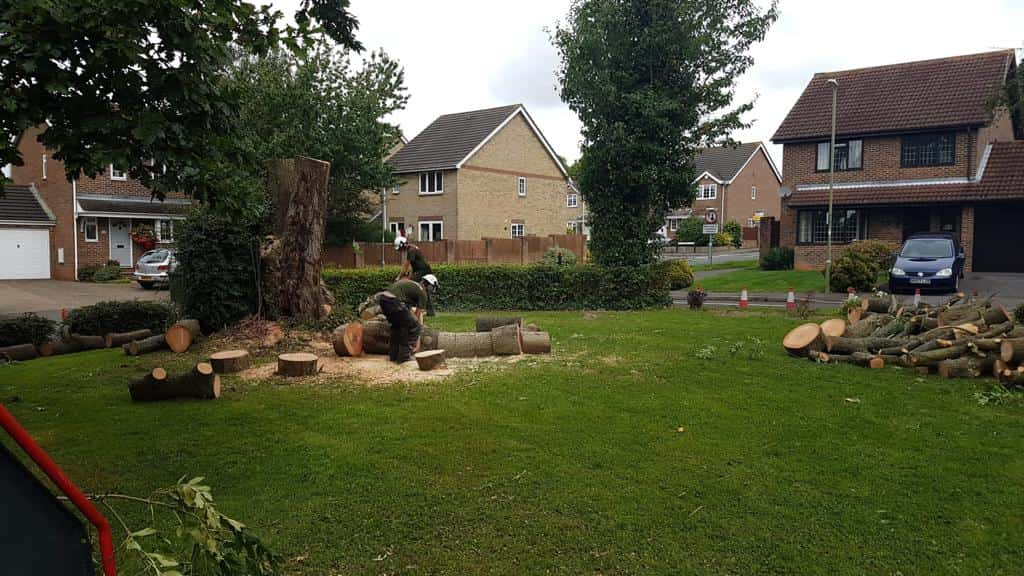
Tree Felling
There are circumstances where retaining a tree is no longer the most appropriate option.
Complete tree removal may be considered where a tree is severely deteriorated, unsuitable for its location or presents problems that cannot reasonably be resolved through pruning.
Before recommending removal, a professional tree surgeon should assess the tree and its surroundings carefully. Where suitable management can retain a healthy tree, this may be preferable to unnecessary felling.
Sectional Tree Dismantling
Not every tree can simply be felled from the base.
Trees growing in restricted gardens may be surrounded by buildings, fences, patios, sheds, planting or other features that leave insufficient space for conventional felling.
Sectional dismantling allows the tree to be removed progressively. Branches are taken down first, followed by manageable sections of the main stem.
Where necessary, specialist rigging equipment can be used to lower sections in a controlled manner.
This makes sectional dismantling particularly valuable for complex tree removals where the surrounding property needs to be carefully protected.
Stump Grinding
Felling removes the main tree, but the stump normally remains in the ground unless further work is carried out.
Stump grinding uses specialist machinery to reduce the remaining stump below ground level.
Removing an unwanted stump can:
- Create additional usable garden space
- Make lawn maintenance easier
- Improve the appearance of the area
- Reduce unwanted regrowth from suitable species
- Prepare the space for future landscaping
Stump grinding can therefore be an important final stage of a complete tree removal project.
Hedge Cutting and Reduction
Tree surgeons frequently manage established hedges as well as individual trees.
Hedge maintenance may include:
- Routine trimming
- Height reduction
- Width reduction
- Reshaping
- Restoration of overgrown hedges
Regular cutting helps keep hedges dense, manageable and visually defined. Where a hedge has been neglected for several years, a more considered restoration programme may be required rather than removing excessive growth in a single visit.
Storm-Damaged Tree Work
Strong winds can cause branches to split, hang or break completely. Trees with existing weaknesses can be particularly vulnerable when exposed to difficult weather conditions.
Following storm damage, professional assessment can identify:
- Hanging branches
- Split limbs
- Damaged sections of the crown
- Newly exposed structural weaknesses
- Trees requiring urgent attention
Damaged trees should be assessed carefully because defects within a canopy are not always obvious from ground level.
Which Tree Surgery Service Do You Need?
The correct service depends on the reason the tree requires attention.
For example, an excessively large but otherwise suitable tree might benefit from crown reduction, while a tree with significant dead branches may only require deadwood removal. Another tree might simply need selective pruning to provide clearance.
A professional assessment considers factors including:
- Tree species
- Age and condition
- Branch structure
- Crown size
- Surrounding property
- Available space
- The reason for carrying out the work
This prevents unnecessary intervention and ensures the work has a clear purpose.
Why Professional Tree Surgery Matters
Tree surgery is not simply about cutting branches until a tree looks smaller.
Different pruning techniques produce different results, and poorly considered cutting can damage the tree’s structure or encourage undesirable future growth.
Professional tree surgeons combine practical skills with an understanding of how trees respond to pruning. They can determine which branches should be removed, how much growth is appropriate to take away and which technique best addresses the original problem.
This considered approach provides much greater value than treating every overgrown tree in the same way.
Why Choose NS Tree Surgery Hindhead?
At NS Tree Surgery Hindhead, we provide professional tree surgery throughout Hindhead, Surrey. Our services cover everything from routine tree pruning and crown management to stump grinding and more complex tree removal.
Every tree is assessed individually so that the work reflects its actual condition and surroundings. Our focus is on carrying out appropriate tree surgery with careful planning, skilled workmanship and consideration for the wider garden.
Whether you need to manage an overgrown canopy, remove dead branches, restore an established hedge or assess a tree that may require removal, professional advice can help determine the most suitable solution.
Conclusion
The most common tree surgery services include pruning, crown reduction, crown thinning, crown lifting, deadwood removal, tree felling, sectional dismantling, stump grinding and hedge maintenance. Although these services may appear similar, each has a different purpose, and choosing the correct technique is important for achieving an appropriate result.
For property owners in Hindhead, Surrey, NS Tree Surgery Hindhead provides professional tree care based on the individual needs of each tree and garden. If you have an overgrown, damaged or difficult-to-manage tree, arranging an expert assessment is the best starting point for understanding what work is genuinely required.
Call us on: 01428 778 689
Click here to find out more about NS Tree Surgery Hindhead
Click here to complete our contact form and see how we can help with your tree needs.